No-knead bread from a tub in the fridge
One dough, stirred together in five minutes, kept cold for up to a week and baked a loaf at a time. The method is easy. Choosing the flour in an Australian shop takes a little more care.
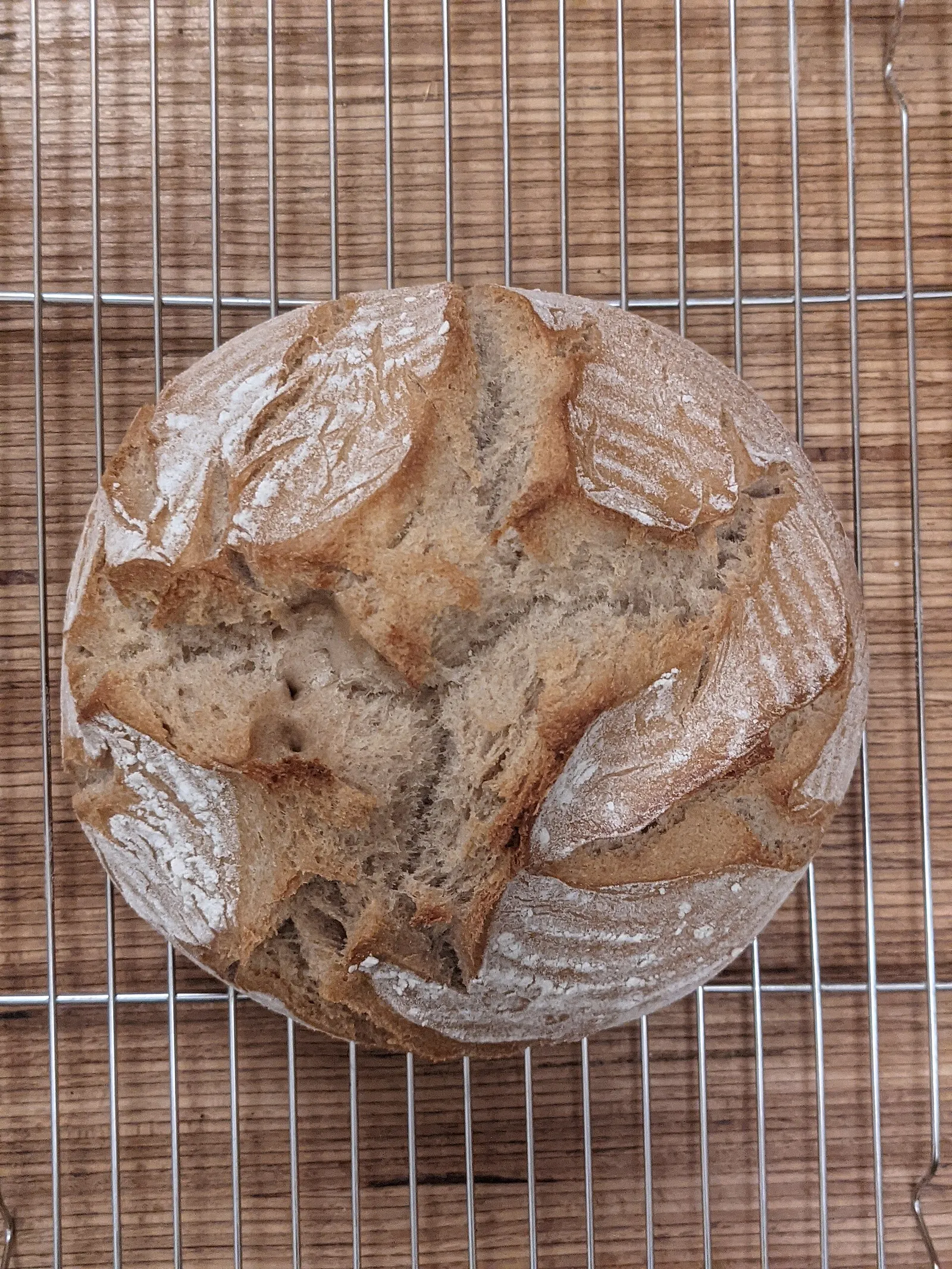
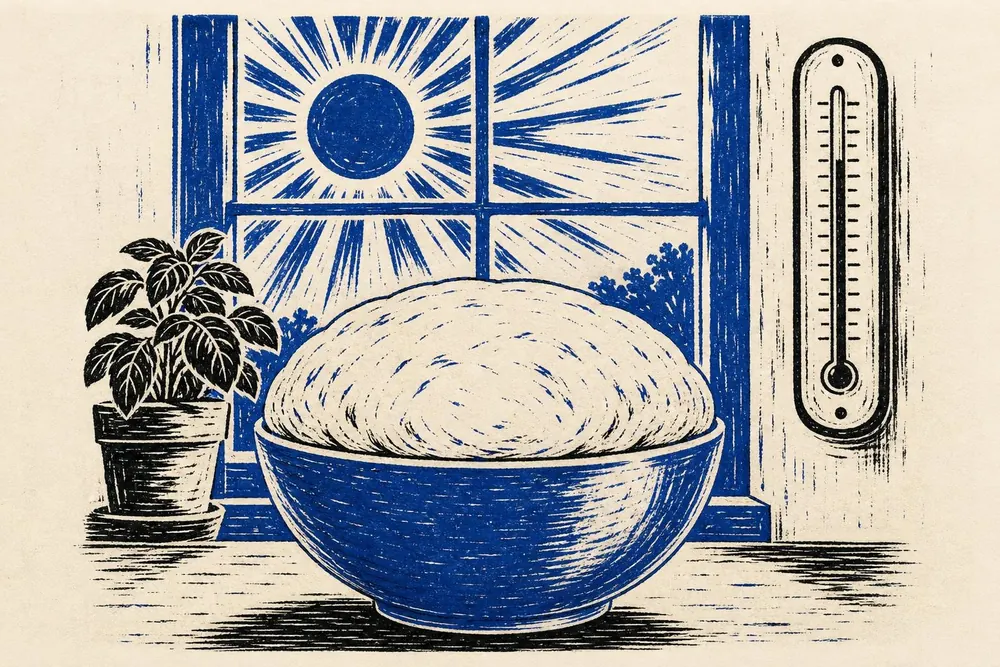
The mixing takes about five minutes: 900 g of flour, 680 g of water, salt and yeast, stirred in a big tub until no dry flour shows. The tub sits on the bench for two hours and then goes into the fridge, where the dough keeps for about a week. On any of those days a piece pulled off, shaped and left for an hour becomes a crusty white loaf after about half an hour in the oven.
The method belongs to Jeff Hertzberg and Zoë François, who published it in 2007 in Artisan Bread in Five Minutes a Day. The quantities below are from King Arthur Baking’s version, written by PJ Hamel, which thanks the two authors and names their book as its inspiration. It was the American flour company’s recipe of the year in 2016.
Why nobody has to knead it
Two of the proteins in flour, glutenin and gliadin, are the ones that make gluten. Wet them and they link up into an elastic web that traps the gas from the yeast and lets a loaf rise. Kneading hurries the linking along, but a mixed dough left alone builds the same web, only over hours. King Arthur’s bakers call this passive gluten development.
The yeast keeps working in the cold as well. The dough climbs the tub and then sinks back during the first day or so, and its flavour changes for as long as it is kept. King Arthur says it gets tangier by the day and that after a full week it “will taste like sourdough”. Hertzberg and François, who store theirs for up to two weeks, write that the flavour deepens, “developing sourdough characteristics”. Because most of this happens at fridge temperature, the dough is less at the mercy of a hot kitchen than one that rises on the bench.
Which flour
The recipe was written for King Arthur’s all-purpose flour, and the obvious Australian translation, plain flour, is a different thing. King Arthur’s all-purpose is 11.7 per cent protein, which is high for the type: Hertzberg puts the ordinary American kind at about 9.8 to 10.5 per cent. One Australian plain flour, at least, looks like that ordinary kind: on its maker’s nutrition panel in November 2026, White Wings plain flour lists 9.7 g of protein per 100 g.
The nearer local match for King Arthur’s flour is the one millers sell for bread. Laucke’s Wallaby, a baker’s flour, averages 11.5 per cent protein, and Lighthouse’s Bread & Pizza flour lists 11.9 g per 100 g. Baker’s flour is therefore what the ingredient list asks for.
Checking a bag is quick. Food Standards Australia New Zealand says the figures in a nutrition panel’s per-100 g column are the same as percentages, so 11.5 g there is 11.5 per cent of what is in the bag. How exactly that lines up with an American miller’s percentage is less certain. Protein is not measured the same way everywhere: Hertzberg notes that European mills measure it after heating off the flour’s water, so that an American flour of 10 per cent would be labelled 12 per cent in Europe. No source we found sets an Australian panel beside an American figure. As printed, the plain and baker’s flours here are about two points apart, which is a real difference; a few tenths between one bag and King Arthur’s may be nothing.
Plain flour is not ruled out. Hertzberg wrote the original master recipe for the ordinary American flour of about 10 per cent, at 680 g of water to 910 g of flour, which is almost exactly the ratio below. It is for King Arthur’s stronger flour that he advises adding water. So on its authors’ word the dough suits flour of about plain flour’s strength. What plain flour gives up is strength. In King Arthur’s account less protein means less gluten, and a weaker web holds less gas and rises less. Neither source says how much lower a plain-flour loaf sits.
More protein than King Arthur’s is no improvement. King Arthur’s own bread flour is 12.7 per cent, and the company says that in this recipe it makes the crust thicker and the crumb less open. Its bakers prefer all-purpose here, and add about two teaspoons of water for each cup of flour when they do use the stronger one.
No-knead white bread from the fridge
Ingredients
| Baker's flour (11.5 to 12 g protein per 100 g) | 900 g | 100% |
| Water, lukewarm | 680 g | 75.6% |
| Table salt | 18 g | 2% |
| Instant dried yeast | 14 g | 1.6% |
The blue figures are baker's percentages: each weight as a share of the flour.
Method
- Weigh everything into a tub or bowl that holds about 6 litres; the dough will rise a long way. The water should feel comfortably warm, about 40°C, though it need not be exact. Stir with a big spoon until no dry flour is left. The dough will be rough and very sticky, and that is all the mixing it gets.
- Cover the tub and leave it at room temperature for 2 hours.
- Move it to the fridge for at least 2 hours and for up to about 7 days. During the first day or so the dough rises and then sinks back. It is meant to.
- To bake a loaf, start about an hour and a half before the bread is wanted. Dust the top of the dough with flour, grease your hands and pull off between a quarter and a third of it, a piece of 400 to 540 g.
- On a floured bench, round the piece into a ball or a longer log. It does not need to be neat. Set it on a tray lined with baking paper and sift a little flour over the top.
- Drape greased cling film over it, or use a reusable cover, and leave it for about 60 minutes, or up to a couple of hours in a cool room. It will spread and settle more than it rises.
- While the loaf rests, heat the oven to 230°C (210°C fan-forced); the source gives 450°F, which is 232°C. Put a shallow metal or cast-iron pan on the lowest shelf, not a glass or ceramic one, and have about 240 ml of hot water ready.
- Cut 2 or 3 slashes a little over 1 cm deep across the loaf with a sharp knife. It may sag slightly, and recovers in the oven.
- Put the tray on a middle shelf, pour the hot water into the pan underneath and shut the door quickly to keep the steam in.
- Bake for 25 to 35 minutes, until the crust is a deep golden brown. Cool the loaf on a wire rack.
Adapted from No-Knead Crusty White Bread by PJ Hamel, King Arthur Baking Company. The weights are King Arthur's. The source names its own all-purpose flour, and we name the Australian flour nearest it in protein. It allows instant or active dry yeast, and we name instant. Its oven temperature and American measures are converted to metric, with a fan-forced figure added. Left out are its options for a stand mixer, a baking stone, a greased tray in place of baking paper, and skipping the two hours on the bench. The method is in our words.