The temperature your recipe leaves out
A rising time holds only at the temperature its author had in mind. When a January kitchen runs hotter than that, the correction is made with the water.
In a test that King Arthur Baking published in 2018, Barb Alpern made one sandwich loaf recipe three times, with the water at a different temperature each time. The two extremes show what the water does. Water at 10 degrees gave her a dough that came off the mixer at 22. Water at 49 degrees gave one at 34. Each dough then had the same hour to rise in the bowl and the same hour in the tin. The cooler one was “definitely sluggish” on its first rise and still baked into a good loaf, a little small. The warmer one over-proofed: its top bubbled and sagged before it reached the oven, the crust collapsed into wrinkles as it cooled, and the flavour she reported was “bitter, acidic”.
Twelve degrees of dough temperature did that, with the recipe and the clock unchanged. An Australian kitchen in January can do to dough what Alpern’s hot water did, which is why a rising time that worked in July can fail at Christmas. The time printed in a recipe is true at the temperature its author had in mind, and the recipe may never state what that was.
The room the recipe was written in
Professional bakers do state it. A wheat dough should be between 24 and 26 degrees when mixing ends, and the worked example in Alpern’s post is set in a room at 22. Outdoors, the mean daily maximum for January is 31.4 degrees in Perth, 30.4 in Brisbane, 28.7 in Adelaide and 21.8 in Hobart. The figures are Bureau of Meteorology averages, from records that begin in 1994 for Perth, 1999 for Brisbane, 1887 for Adelaide and 1882 for Hobart. They are outdoor readings, and a kitchen has its own climate. The number that counts is the one on a thermometer left on the bench.
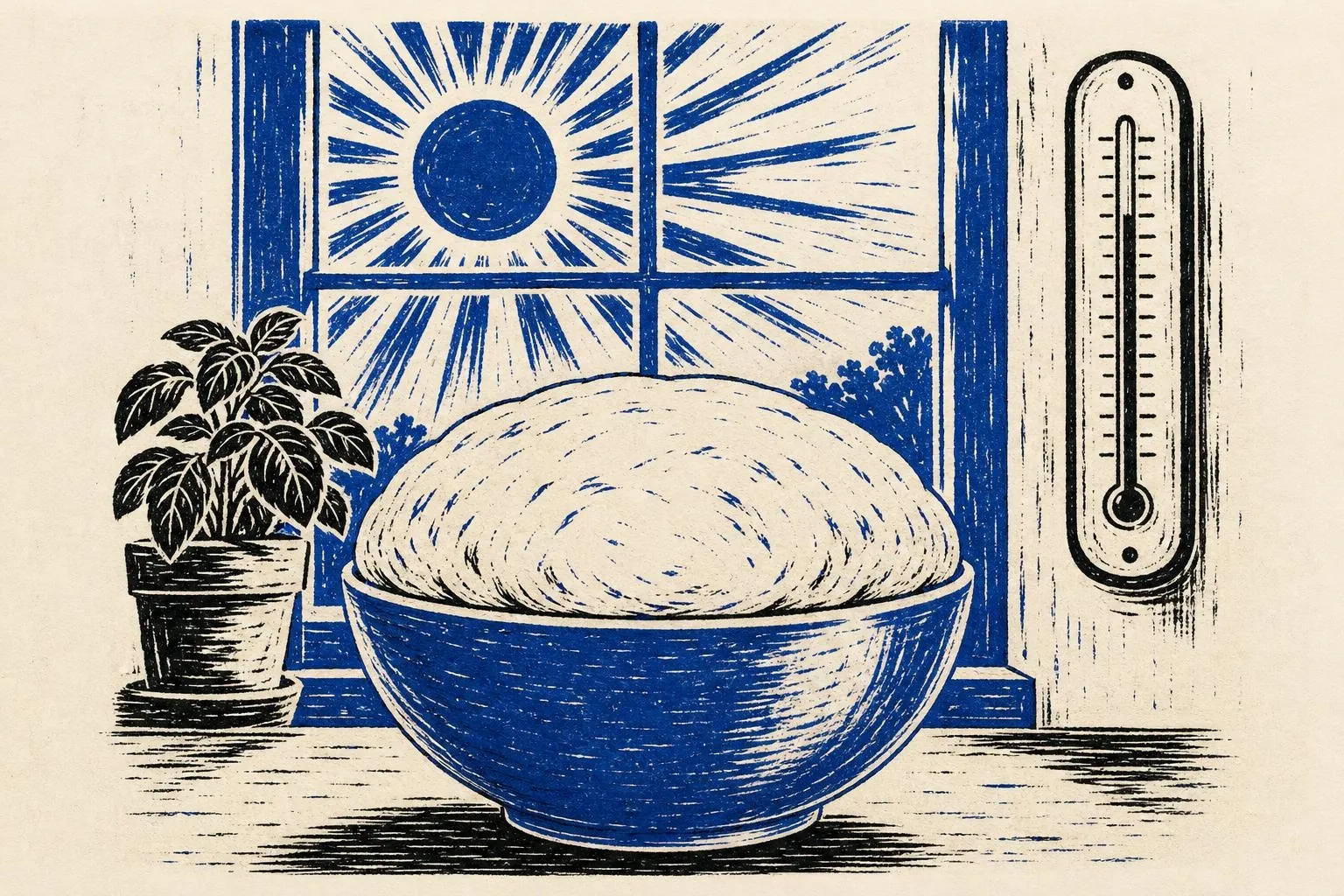
Warmth speeds the yeast. Bread yeast grows fastest in the mid-30s, well above the baker’s target, and the target is set lower on purpose: the acids that give bread its flavour are produced at considerably lower temperatures. A hot kitchen pushes the dough towards the temperature the yeast likes best and the flavour does not.
How much faster it goes has no single figure, because the answer depends on the recipe as well as the thermometer. Of a kitchen at 28 to 32 degrees, Maurizio Leo, who runs the sourdough site The Perfect Loaf, writes that fermentation “can move twice as fast as a recipe anticipates”, so that a first rise meant to take four or five hours may be over in two to two and a half. A dough left past the end of that shortened rise turns sticky and gassy, and its structure breaks down.
Working out the water
Four things set the temperature of a dough when it leaves the bowl: the room, the flour, the water, and the heat of mixing, which bakers call friction. Water is the one that can be changed in a minute. So the professional method fixes the dough temperature wanted and works backwards to the water.
Friction is the soft part of the sum. King Arthur calls its own figures an approximation, the heat varies with the machine, the speed, the time and the size of the batch, and Leo allows nothing at all for mixing by hand. A bakery finds its mixer’s figure from a trial dough, and a home baker can do the same: take the dough’s temperature when mixing ends, and if it has come out warm, allow more for friction next time.
For a 25-degree dough, with the flour at the temperature of the kitchen and friction taken as 4 degrees by hand and 13 in a mixer, the sum gives this:
| Kitchen and flour | Water, kneading by hand | Water, stand mixer |
|---|---|---|
| 22 | 27 | 18 |
| 26 | 19 | 10 |
| 30 | 11 | 2 |
| 34 | 3 | below freezing |
In the last cell the sum comes to six below zero, which no water can be. When the water cannot be made cold enough and the dough comes off the mixer too warm, it goes into the fridge.
Alpern adds a caution that bears on the hot rows of the table. A home baker’s batch is small, and the sum does not fully account for what the room does to it, least of all in a very hot or very cool kitchen. Her suggestion for a hot day is to aim a little lower, at 23 degrees, say. Each degree taken off the target takes three off the water.
The cold tap may not be cold
Mains water in Australia’s major supplies runs from 10 to 30 degrees, so in summer the cold tap can deliver water warmer than the dough is meant to be. Measure it before trusting it. Leo keeps water for mixing in a large bottle in the fridge and blends it in the bowl with room-temperature water until the thermometer shows what he wants, and adds ice when cold water is not enough.
Cold water changes how the yeast goes in. King Arthur’s advice is to stir instant yeast through the flour before adding any water cooler than 21 degrees. Active dry yeast may not activate properly in cool water, and is first dissolved in a few spoonfuls of the recipe’s water warmed to 43 degrees and left for 10 to 15 minutes.
When to use the fridge
The sum sets where the dough starts. After that it sits in a warm room and slowly warms, so the rise will still be quicker than the recipe says, and the dough’s progress has to be the guide where the recipe offers the clock. If the dough has come off the mixer too warm, Leo’s remedy is to put it in the fridge, covered, for 15 to 30 minutes before going on, which takes the edge off without chilling it through.
The fridge is also the answer when the sum asks for water colder than the kitchen can supply, or when nobody will be home to watch a fast dough. A dough left to rise overnight in the cold moves so slowly that the window for baking it is much wider than at room temperature, writes Rossi Anastopoulo of King Arthur, who adds that the long, cold ferment gives a better flavour as well. Leo’s figure for the fridge itself is 3 to 4 degrees, checked with a thermometer, because a home fridge often runs colder than its dial says, and below about 2 fermentation can nearly stall. Cover the dough tightly, or the fridge will dry it out.