What the law puts in Australian bread
Folic acid and thiamin go in at the flour mill, iodine arrives with the salt. The rules take up five short sections of the Food Standards Code, and each was written for a different problem.
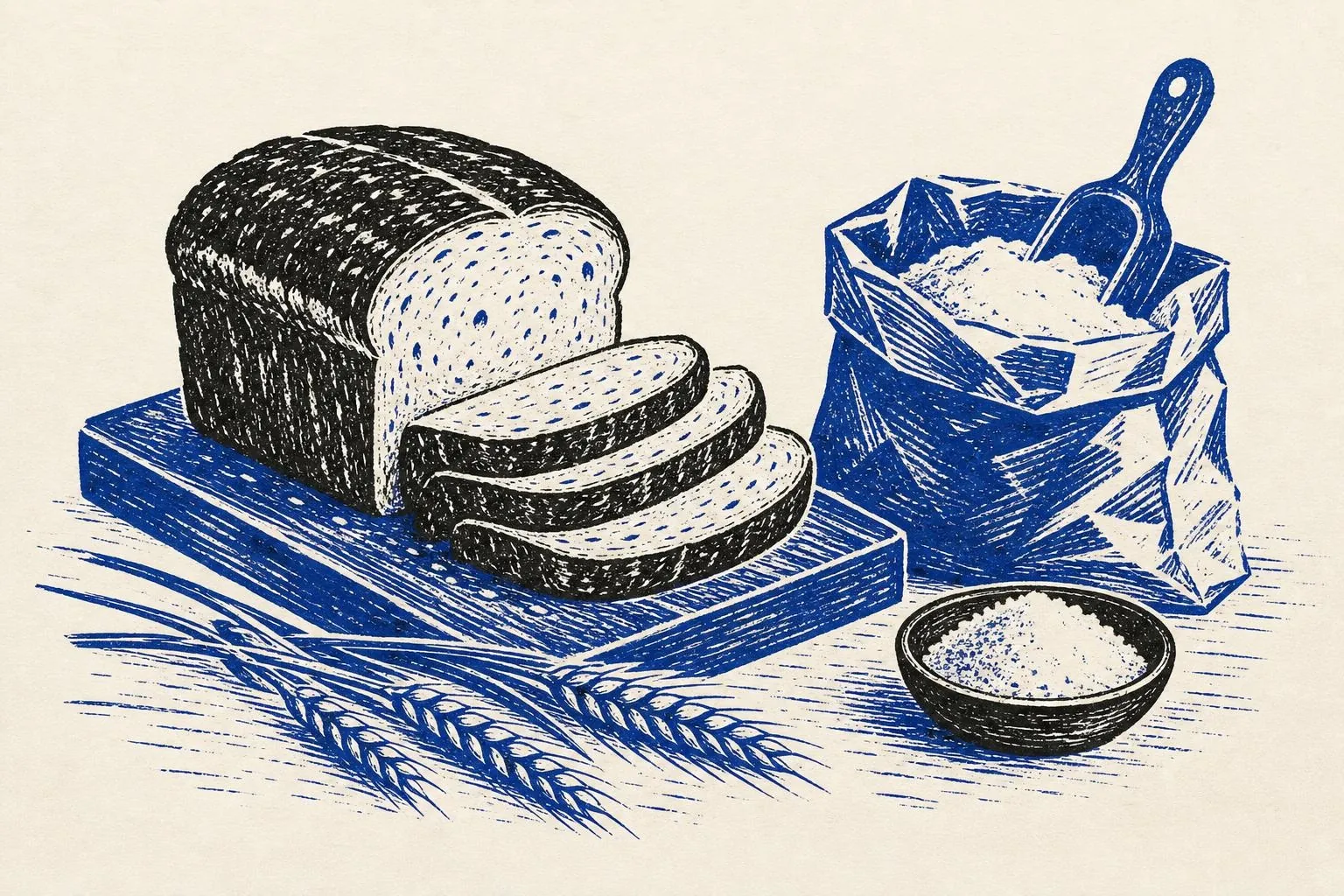
Three things are in an ordinary Australian loaf because the law says they must be. The wheat flour it was baked from has had two B vitamins added to it, folic acid and thiamin, and the salt in the dough is iodised. None of the three is a baker’s choice. They are requirements of Standard 2.1.1 of the Australia New Zealand Food Standards Code, which gets through everything it has to say about bread in five short sections.
The quantities are small and exactly stated. “Wheat flour that is sold as suitable for making bread” must contain no less than 2 and no more than 3 milligrams of folic acid in each kilogram, which is two to three parts in a million. It must also contain no less than 6.4 milligrams of thiamin in each kilogram. Folic acid has a ceiling as well as a floor; thiamin has only the floor. The salt rule gives no number of its own. It says that iodised salt “must be used for making bread” wherever salt would ordinarily be used. The definition is left to the code’s standard on salt, under which iodised salt carries between 25 and 65 milligrams of iodine per kilogram.
So the work is split between two trades. The vitamins are the miller’s job, done before the flour reaches a bakery. The iodine is the baker’s, and all it asks is that one kind of salt be used instead of another.
| Amount required | Since | Applies to | Exempt | |
|---|---|---|---|---|
| Thiamin | At least 6.4 mg per kg of flour | January 1991 | Wheat flour sold as suitable for making bread (Australia only) | Flour for pizza bases, breadcrumbs, pastries, cakes, biscuits and crackers; bread represented as organic |
| Folic acid | 2 to 3 mg per kg of flour | 2009 | Wheat flour sold as suitable for making bread | The same |
| Iodine | Iodised salt, itself 25 to 65 mg of iodine per kg | 2009 | Salt used in making bread | The same foods and organic bread; salt put on the surface of a loaf |
Three problems, eighteen years apart
Thiamin came first. Food Standards Australia New Zealand (FSANZ) says the requirement dates from January 1991 and was meant to make Wernicke-Korsakoff syndrome less common. It describes the syndrome as “a potentially fatal neurological disorder caused by thiamin deficiency”. What became of the syndrome afterwards was measured in forensic autopsies. A study in the Medical Journal of Australia in 1998 examined the brains from 2,212 consecutive autopsies at the New South Wales Institute of Forensic Medicine in 1996 and 1997 and found the syndrome in 25 of them, or 1.1 per cent. A similar study of forensic cases in Western Australia between 1973 and 1981 had found it in 4.7 per cent. The authors concluded that there had been “a significant reduction in the prevalence of WKS in Australia since the introduction of thiamine enrichment of bread flour”. Their evidence is that one comparison, between two series of forensic autopsies in different states, which they judged to be similar populations. They did not put the whole of the fall down to the flour. They offered four possible explanations: more thiamine in the diet, improvement in people who already had the syndrome, a general rise in Australians’ health that had nothing to do with the rule, and doctors more alert to treating patients at risk with thiamine. “It is likely that each of these explanations played a part”, they wrote, and the weight of each would “only be clarified with time and further study”.
The bread itself, by FSANZ’s account, went without formal national monitoring of its thiamin until surveys in 2010 and 2012, which found the vitamin present in the expected amounts. The agency could not analyse what Australians had taken in before the rule, because the food consumption data from before 1991 were not available.
Folic acid and iodine arrived together. Both requirements were accepted in 2007 and took effect in September and October 2009. Folic acid is a form of folate, the B vitamin found naturally in green leafy vegetables, and FSANZ’s explanation for adding it turns on timing. A baby grows fastest in its first weeks, in the agency’s words “often before a woman is aware she is pregnant”. The neural tube closes very early in pregnancy too, and one that fails to close leaves a neural tube defect, of which spina bifida is one.
The iodine rule had a different target. Iodine deficiency had come back in parts of Australia and New Zealand, FSANZ says, and the bread rule was written to deal with it. Among the problems the agency attributes to a shortage of iodine is “impaired neurological function in babies and young children”.
When ministers agreed to these two rules they asked for an independent review, and its health findings were published in 2016 by the Australian Institute of Health and Welfare. The institute reported a statistically significant 14.4 per cent decrease in the rate of neural tube defects after fortification, from 10.2 to 8.7 for every 10,000 conceptions that resulted in a birth. Its study population was New South Wales, Queensland, Western Australia, South Australia and the Northern Territory; data from the other jurisdictions were unavailable or not good enough. Among Aboriginal and Torres Strait Islander women the rate fell by 74.2 per cent, from 19.6 to 5.1. The institute attached a caution to all of it: the period studied after fortification was short and the defects are rare, so the rates need continued monitoring to confirm that the reductions last.
On iodine, the same report found that in Australia the general population was taking in enough to address the mild deficiency that had re-emerged. Its measure was the median concentration of iodine in urine, which stood at 131 micrograms per litre against an adequate range of 100 to 199. For pregnant women the figure was 116, which the institute judged still inadequate for the increased requirements of pregnancy and breastfeeding. New Zealand’s result was weaker. The institute found a modest improvement in iodine intakes there, with some groups still at risk of mild deficiency: the median for adults aged 18 to 64 was 73 micrograms per litre.
The mills were checked too. In 2010 the state and territory food authorities surveyed 21 flour mills and analysed samples of their flour. Sixteen had folic acid within the limits, and FSANZ records “some variance” at the others, slightly over or slightly under.
What counts as bread
Almost everything in the standard depends on a definition. Bread, in the code, is “a food that is made by baking a yeast-leavened dough prepared from one or more cereal flours or meals and water”, with or without other foods added. One section then consists of a single sentence: “A food that is sold as bread must be bread.”
The exemptions are a list of things that are not quite bread. Pizza bases, breadcrumbs, pastries, biscuits and crackers are outside both rules, and so is the flour used to make them. Cakes are outside too, and the standard specifies that for this purpose brioche, panettone and stollen are cakes. The other exemption is of a different kind: bread that is represented as organic need not contain any of the three.
Two smaller allowances apply to salt. A baker may put salt that is not iodised on the surface of a loaf (the standard’s own example is rock salt), and may add another food that contains ordinary salt to the dough.
The vitamin rule also depends on wheat. A bread made from rice, corn or rye, with no wheat flour in it, does not have to contain folic acid, FSANZ says, though a manufacturer may add it. The salt rule has no such limit.
For anyone baking at home, the words that matter are “sold as suitable for making bread”. FSANZ’s reading is that flour and flour mixes sold for baking bread at home must have folic acid in them and that other types of packaged flour need not. Bread mixes for home use are outside the iodine requirement, although their makers are allowed to use iodised salt. The label settles it for any particular bag or loaf, because folic acid, which is sometimes listed as folate, and iodised salt must each appear in the ingredient list of a food that contains them. Unpackaged bread, such as a loaf baked and sold in the same shop, does not have to carry that list.
New Zealand shares the code but not every line of it. The iodised salt rule has applied in both countries since 2009. Folic acid became compulsory in New Zealand’s non-organic bread-making flour on 14 August 2023, and a note in the standard still confines the thiamin paragraph to Australia.