Federation, William Farrer's compromise wheat
He spent twenty years breeding wheats to beat rust and mill a strong flour. The one that took over Australian paddocks from 1910 to 1925 did neither thing well. It filled more bags.
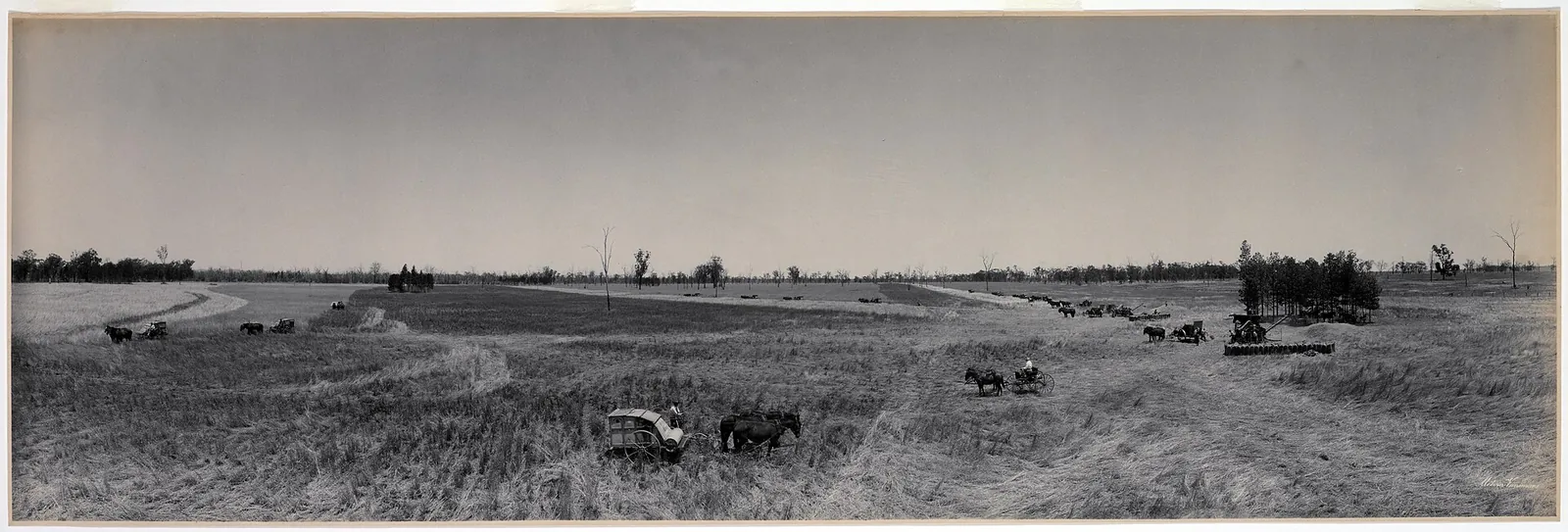
By the early 1920s the Australian wheat harvest had changed colour. The old varieties ripened to a golden yellow. The wheat that had taken their place ripened darker, and a bulletin issued by the New South Wales Department of Agriculture in 1922 recorded that “the golden yellow characteristic of old time Australian harvest-fields has been gradually changed to a dull bronze through the ever-increasing popularity of Federation wheat”.
Nobody had chosen Federation for its looks. It was a short wheat with brown heads, and its spread was later put down to “sheer ability to yield well, despite an unattractive appearance in the field”. The man who bred it, William Farrer, had by then been dead for sixteen years. He had named it in 1901, the year the colonies federated, and it was a compromise. Farrer wanted wheats that stood up to rust and milled into strong flour, the trade’s word for flour that bakes well, and he had wished never to put out a wheat whose grain was not of the top quality. Frederick Guthrie, the chemist who milled and baked his wheats, wrote of Federation that it was “rather rust and smut liable”, and that “though a good milling wheat it is not a hard wheat, and does not produce strong flour”. What it did was out-yield the wheats around it, and for fifteen years, from 1910 to 1925, no variety was more widely grown on the continent.
To see why a variety of wheat could be a public matter, start with the flour New South Wales was making when Farrer began. George Valder, the Department of Agriculture’s under-secretary in 1922, wrote that he had lately been reminded how government institutions calling tenders for flour used to stipulate “best Adelaide”, which shut out the local product by name. He remembered, too, a flour contract offered by the French administration in New Caledonia in the late 1890s that asked for at least 9 per cent gluten, the protein then taken as the measure of a flour’s strength. The best New South Wales wheat of the day had 8.
Poor flour was the lesser trouble. Rust, a disease of the wheat plant, could overtake an entire crop. In 1889 the colonies had one of the worst harvests in their history and millers had to import grain. The damage done by rust was reckoned at more than £2,500,000, and in 1890 the Victorian Minister for Agriculture called a Rust-in-Wheat Conference. It met again in Sydney, Adelaide, Brisbane and Melbourne before it was discontinued in 1896.
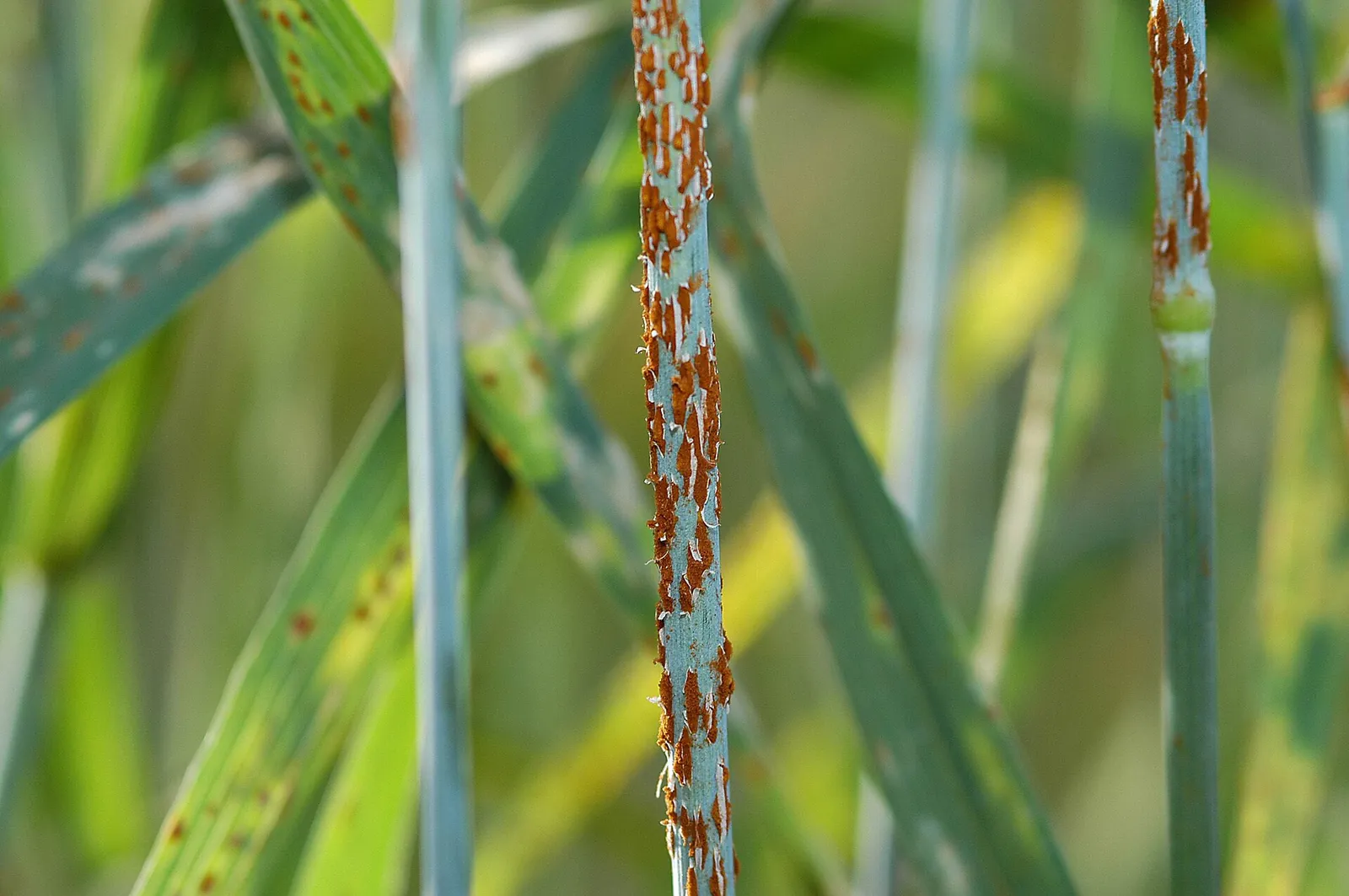
Among the papers put before the first conference was a letter from a property called Lambrigg, on the Murrumbidgee near where Canberra now stands. Its writer, a former surveyor named William Farrer, said he had “given practical attention to the subject of rust in wheat for four years”.
Farrer was born in Westmorland in 1845, went to Christ’s Hospital in London on a scholarship, won medals there for mathematics, and graduated from Cambridge in 1868. He began to study medicine, contracted tuberculosis, and sailed for Australia about 1870. He meant to buy a sheep station, and went as tutor to the Campbell family at Duntroon to learn the country first. Then he lost money in mining speculations. In July 1875 he passed the examination for licensed surveyor, third of twenty-two candidates, and for most of the next eleven years he surveyed for the Lands Department around Dubbo, along the stock route from Nyngan to Cobar, and at Cooma. In 1882 he married Nina de Salis, whose father held Cuppacumbalong station. In July 1886 he resigned and settled at Lambrigg.
The idea that occupied him there had begun as an argument. In 1882 he had fallen into a dispute with the Australasian newspaper, which held that crossing wheats to breed resistance to rust was not practicable. Farrer thought it was. Guthrie, who knew him well, observed that controversy in print “was always one of Farrer’s strong points”.
His plots at Lambrigg covered less than three acres, and he sowed half of that each year. He made his first crosses in 1889. Only one took, and it proved useless. He went on, moving pollen from one plant to another with hairpins until he could get forceps, in a district where little wheat was grown. To many people he was “a crazy faddist” wasting his time on “pocket handkerchief wheat plots”. An uncle in England, a rich man, gave him the choice of coming home to inherit a fortune or being disinherited. He stayed. Until 1898 he, his wife and her father lived on their own means.
What he was doing on those plots he explained to one of the rust conferences with an example. Cross a late wheat that resists rust with an early one that does not, grow a hundred plants from the cross, and they will all differ. Perhaps one will have both qualities in full. Five will have strong resistance and be moderately early, five the reverse, and the other eighty-nine will fall somewhere between their parents. The breeder’s job is to find the eleven, work which he said required “close attention, care, patience, thoroughness, and system”. The system, by his own account, was his own. Gregor Mendel’s work on inheritance, on which plant breeders later came to rely, had not yet been rediscovered, and Farrer does not seem to have known it until about 1905. That year he told Professor R. H. Biffen, the Cambridge plant breeder, that his system of fixing a variety “was adopted from what appeared to me to be common-sense considerations”, with no theory of Mendel’s to work from.
A cross might yield a few ounces of grain after two or three seasons, and there the method stopped, because nobody could say what kind of flour a few ounces would make. No miller would halt a mill to grind it. Guthrie, appointed the department’s chemist at the start of 1892, took the problem on. He got hold of a pair of small rolls and, with the help of the head miller at Gillespie Brothers in Sydney, worked out how to imitate the operations of a large mill. He could mill a sample of 50 to 100 grams, measure how much flour it gave and how strong it was, and bake it into a loaf. Farrer could now throw out scores of crosses before he had spent years multiplying them. Guthrie’s entry in the Australian Dictionary of Biography says that this partnership of breeder and chemist was unique at the time, and that selecting for grain quality was something overseas breeders had hardly considered.
Between them they settled on a plan. The Fife wheats of Canada set the standard for milling and baking and had stiff straw, but they ripened late. Indian wheats ripened early, which let them escape most of the rust and the hot dry winds that summer brings, and they held their grain in the ear. Crossing the two gave Farrer early wheats with good flour, one of which, a cross of Improved Fife with an Indian wheat called Etawah, he named Yandilla. These wheats did not so much resist rust as finish before it could do its worst. C. W. Wrigley, who wrote Farrer’s entry in the Dictionary, says that he “was not so successful in producing rust-resistant varieties as popular legend credits him”.
The millers did not want them. They were used to the soft white grain of the old Purple Straw wheats, and hard grain meant changing their methods and their machinery. The last rust conference, in 1896, said in its report that their opposition “has no legitimate foundation, but arises either from misconception or from conservatism”. That year’s harvest then made the case for hard wheat. Local grain ran short, the millers had to import wheat, and what they bought came mostly from Duluth in Minnesota and was Fife wheat of the type Farrer had been crossing. Having altered their mills to grind it, they came round to his.
The farmers had a different complaint. In a season without disease the old Purple Straw still gave more grain in many districts than Farrer’s strong wheats. He and Guthrie came to accept that yield needed more weight, and that the way to get it was to cross the new wheats with the old favourites.
In 1895 Farrer crossed Yandilla with a Purple Straw he knew as 14A. The seed was sown the following year, and the plant grown from the last seed in the plot was noted as “specially fine with good brown heads and strong straw”. Further selection from it gave the wheat he named Federation in 1901. By then he had resources: in September 1898 the department had made him its Wheat Experimentalist at £350 a year, about what it paid its botanist, and the experiment farms at Wagga, Hawkesbury, Bathurst and later Cowra could grow a promising wheat in quantity for distribution. Guthrie dates Federation’s release to farmers to 1902; the Australian Museum gives 1903.
It suited the country. It ripened early, it stood on a short, strong straw that fitted Australian harvesting methods, and it produced, in Guthrie’s words, “the maximum amount of grain for the minimum amount of straw”. It reached Victoria in 1904. By 1909 a quarter of that state’s wheat land was under Federation, which was yielding three to four bushels an acre more than other varieties, and Victoria’s Director of Agriculture put the extra value of the 1909–10 harvest at £250,000.
Farrer saw only the start of this. He died of heart disease on 16 April 1906, still in the department’s service, and was buried on the hilltop behind the house at Lambrigg.
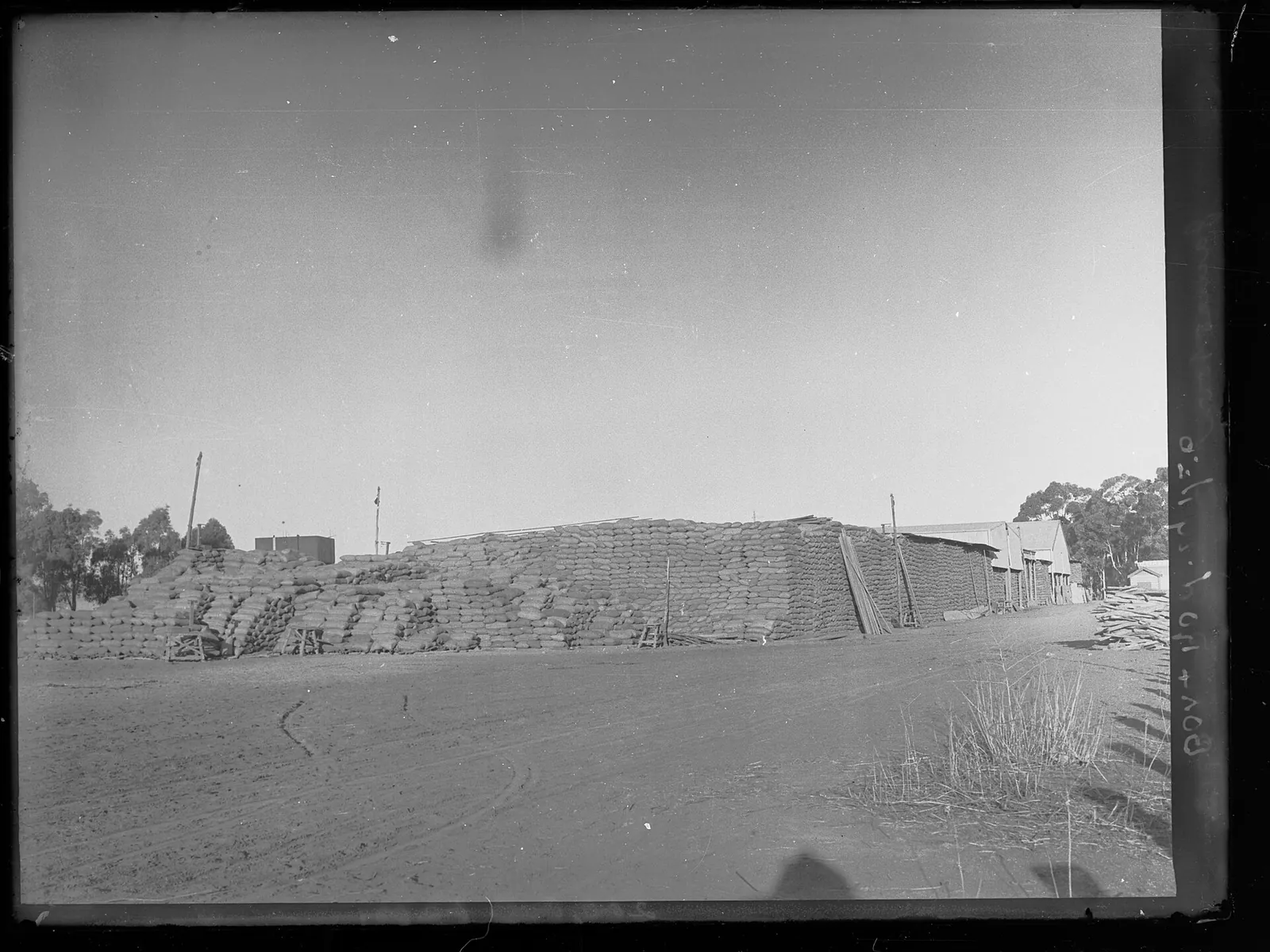
The figures that followed explain the bronze paddocks. The area under wheat in New South Wales grew fourfold between 1897 and 1915, much of it in drier districts. Condobolin had been regarded as outside the wheat belt altogether. A. H. E. McDonald, the department’s chief inspector, reckoned in 1922 that Farrer’s wheats averaged at least two bushels an acre more than other kinds on a state average of about twelve, which he called “really the margin of profit”. In 1919–20 the state bought more than a million bushels of seed wheat, taking sound grain of any variety, and 80 per cent of what came in was Federation.
The grain trade measured the change in shillings. G. W. Walker, of a Sydney grain company, wrote that before Farrer’s varieties Australian wheat had sold at two to three shillings a quarter below the grain of other countries, and that within the past ten years it had matched them and at times sold at a premium. Farrer’s wheats were by then grown on the Pacific coast of the United States, in India, and in Chile and Peru. A young departmental scientist, J. P. Shelton, described Australia as having been “in 1898 a non-exporting wheat country, and in 1922 one of the controlling factors in the European wheat market”.
Most of these figures come from the bulletin of 1922, which Guthrie compiled for the trustees of the Farrer Memorial Fund. It is a tribute, written by friends, and it should be read as one. It is also frank about what Federation was not, and it closes by predicting the end of its own subject. Guthrie wrote that “his monument is set up in nearly every ripening field of wheat in this and the other States”, and in the same sentence that Farrer wheats, “now at the height of their popularity”, would in time “be replaced in general favour by varieties which will be produced in the future, largely as the result of his own labours”.
“His monument is set up in nearly every ripening field of wheat in this and the other States”
That is close to what happened, and the Memorial Fund is one place to follow it. The fund itself was a small thing. A public subscription after Farrer’s death raised £1,030, a response Guthrie called “rather disappointing”, and in 1911 the money was vested in trustees to pay for a research scholarship in wheat.
The first scholar was W. L. Waterhouse, then a student in the University of Sydney’s new agriculture course, who by Guthrie’s record held it in 1912–13 for a study of superphosphate and wheat yields. A later one, Shelton, went to Cambridge to study under Biffen and came back with a verdict on Farrer’s technique. Farrer had often crossed plants that were themselves unfixed crosses, and Shelton judged the habit “diametrically opposed to the modern methods based on the knowledge of Mendelism”: it had reduced his chances of getting the combination he wanted, though where it succeeded it saved years. The correction came from a man the memorial had paid to train. Meanwhile J. T. Pridham, who had lived at Lambrigg for three years as Farrer’s assistant and then succeeded him, selected out of Federation a line with flinty grain and stronger flour and released it in 1914 as Hard Federation, which millers took to for its flour.
The wheats that led after Federation were bred by Farrer’s colleagues and by the memorial’s first scholar. G. L. Sutton had become Farrer’s friend while on the staff of Hawkesbury Agricultural College, opened the experiment farm at Cowra in 1905, and took charge of wheat breeding in New South Wales when Farrer died. In 1911 he began work in Perth, where he went on breeding from young crosses made in New South Wales. One of them, between a South Australian wheat called Gluyas and Farrer’s own early variety Bunyip, he released as Nabawa: in 1918 by his entry in the Dictionary, in 1915 by a 1976 paper in the Journal of the Royal Society of Western Australia. The Dictionary calls Nabawa Australia’s premier wheat until the 1930s, when it gave way to Bencubbin, a cross of Nabawa back to Gluyas, which led in South Australia and New South Wales through the 1940s. Then came Gabo, released by the University of Sydney in 1945, which was for a time the leading wheat in Australia and gave high yields as far away as Mexico. Its breeder was Waterhouse, the first Farrer scholar, and one of the lines he bred it from was a Bobin wheat sent to him by Pridham.
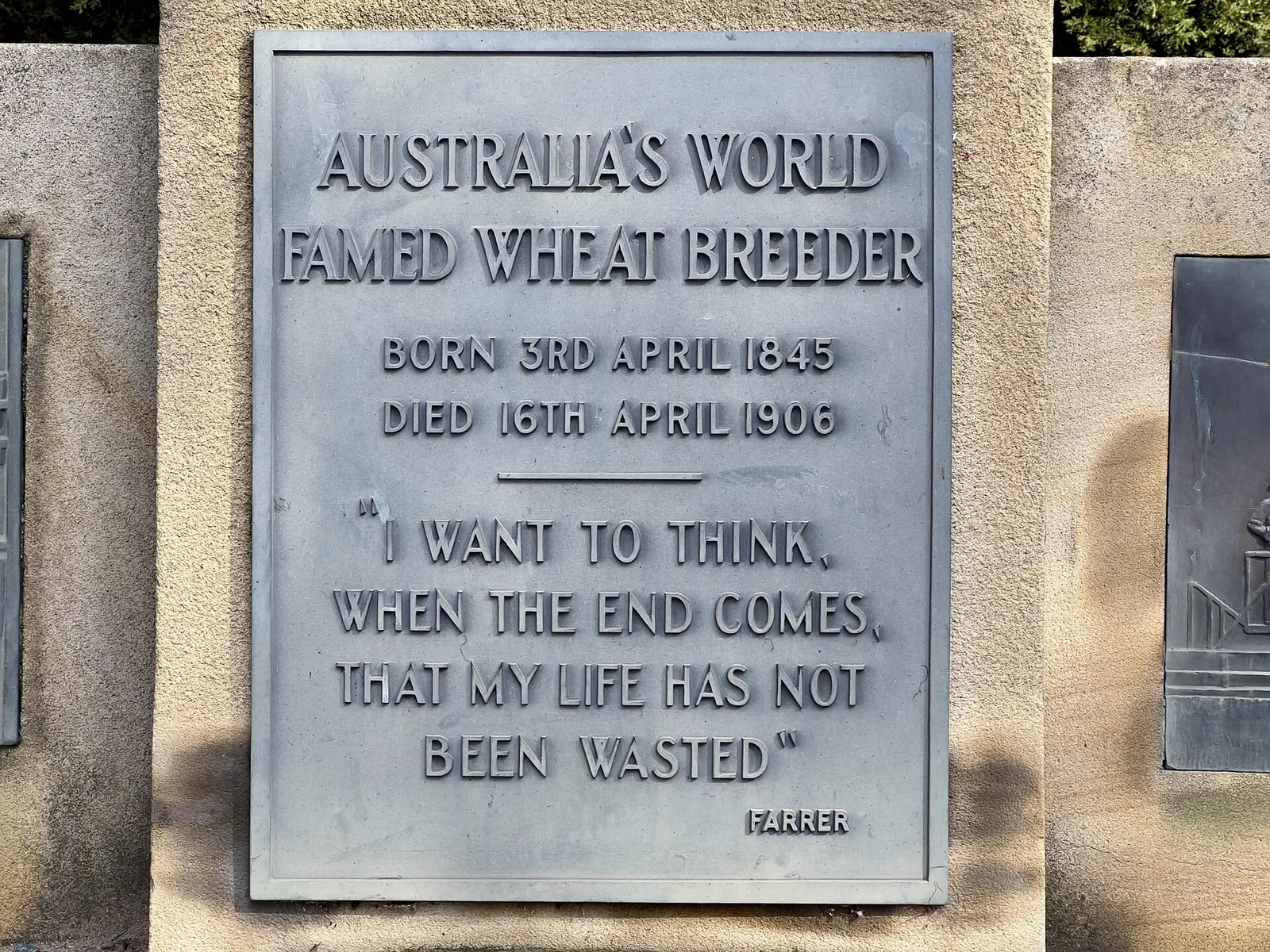
The public honours arrived as his wheats were leaving the paddocks. The Commonwealth put a granite column over the grave at Lambrigg and unveiled it on 16 January 1939. When decimal currency came in, in 1966, the $2 note paired John Macarthur with Farrer, wool with wheat, and the Reserve Bank’s account of the design says the wheat drawn on it is Federation.
The line of descent grows faint after that. Since the 1960s Australian breeders have made wide use of semi-dwarf wheats from the International Maize and Wheat Improvement Center, and by 2003 varieties derived from them covered about 98 per cent of the country’s wheat area. A 2017 study of 482 Australian varieties released between 1840 and 2011 found that those released after 1970 stand genetically apart from the earlier ones. The same study names two events as having defined Australian wheat: the arrival of the semi-dwarfs, and before it Farrer’s introduction of earlier-flowering wheats at the start of the twentieth century. It does not put a figure on how much of Federation is left in the flour sold today. Two things plainly outlasted it. The crop still runs to the early calendar Farrer bred for, and milling and baking a new wheat before it is released, which Guthrie began with a pair of small rolls in 1892, became an integral part of wheat breeding.
Federation itself was still in the seed store in 2020, when the University of Sydney marked sixty years of its Plant Breeding Institute at Narrabri by sowing fifteen varieties going back to 1901, so that a visitor could see a hundred years of breeding within a few hundred metres. Federation was the oldest of them. Guy Roth, the university’s director of northern agriculture, told the ABC what the walk would show: the wheats “go from being taller with larger biomass through to the more modern varieties which are shorter with higher grain yields”. Wheat is now sown in May and generally harvested in November, he said, where the European wheats grown before Federation were only flowering in November. After harvest the fifteen would be tested for quality. “We’ll make some bread and scones and bickies with it as well.”